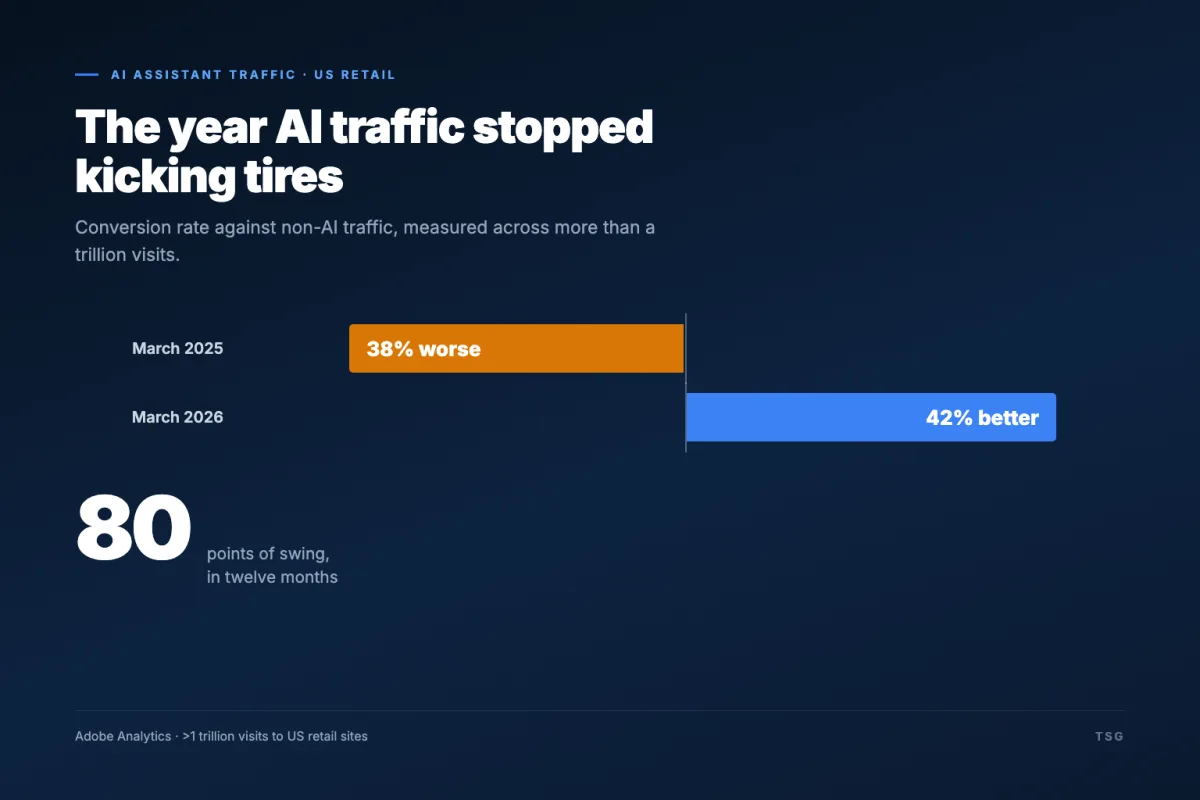
Twelve months ago, traffic from an AI assistant converted 38 percent worse than everything else. Now it converts 42 percent better. That eighty-point swing is the most important number I know about where business is going.
Twelve months ago, traffic arriving from an AI assistant was the worst traffic you could get. Adobe tracked it across more than a trillion visits to US retail sites, and in March of 2025 it converted roughly 38 percent worse than non-AI traffic. Which is about what you would expect from people kicking tires.
By March of this year that same traffic converted about 42 percent better.
That is an eighty-point swing in twelve months, and it is the single most important number I know about where business is going. Shopify's president said something similar on their November earnings call -- AI-driven traffic to Shopify stores up around seven times since January, and orders attributed to AI search up around eleven times.
Something changed, but it was not the shoppers. What changed is that the assistants stopped being a curiosity people played with and started being the thing that does the legwork.
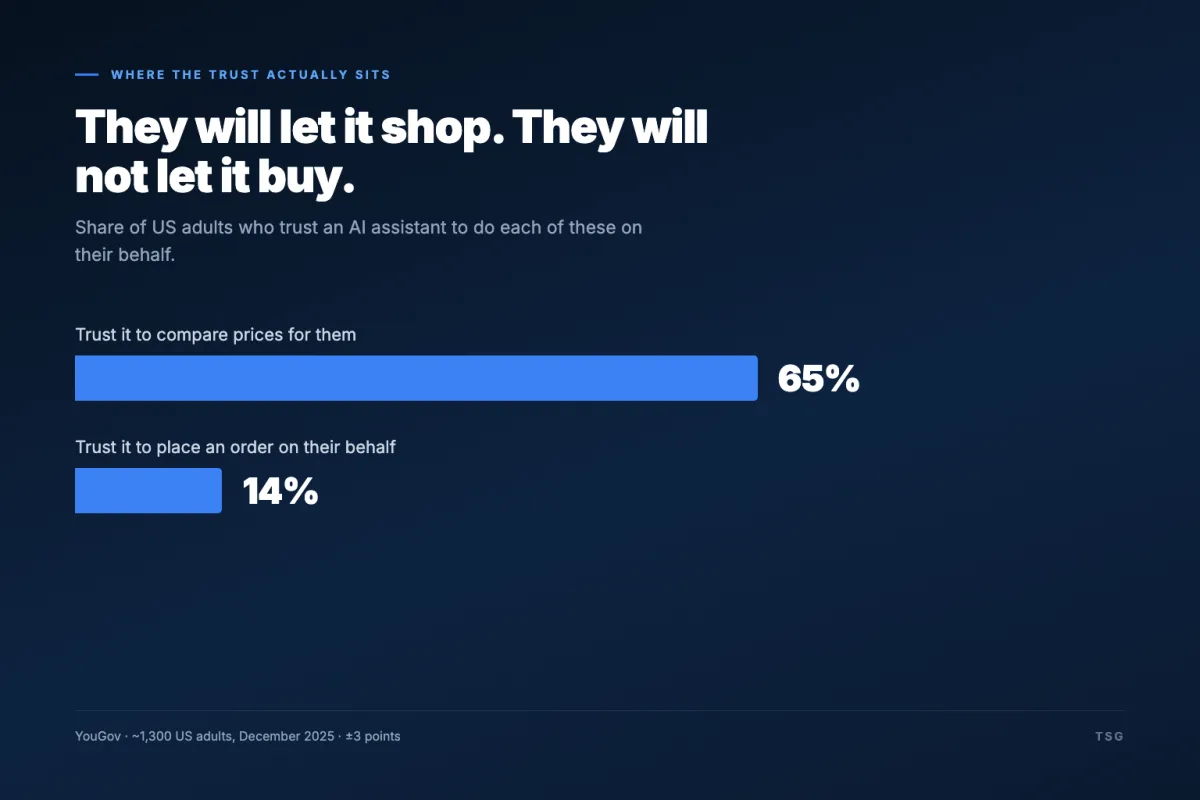
Look at where the trust actually sits, b/c it is more specific than the headlines suggest. YouGov asked about 1,300 US adults in December. Around 65 percent said they trust AI to compare prices for them. Only 14 percent said they trust it to place an order on their behalf.
Worldpay found the same shape across seven countries. Of the shoppers willing to let an agent into the payment step at all, 59 percent still want to approve every purchase themselves.
So the agent is not replacing the buyer. It is replacing the part of buying that nobody enjoyed.
It reads the pricing pages. It figures out who actually serves your zip code, who takes your insurance, who can do it this week. And then it hands a human three options and a recommendation, and the human says yes.
That is the whole shift, and the implication for your company is not subtle. A machine is now doing the research step that used to happen on your website, and it is doing it before anybody sees your website.
My wife runs an immigration exam clinic, and less than three weeks after Meta launched Muse, a patient walked in already knowing what we charge and how fast we are. He had not called. He had asked Muse, and it read our site and gave him the answer he came for.
And it could do that because the answers were there in a form it could read. Prices in plain text. Hours and credentials in structured data. A file on our site named llms.txt that states what we sell and what it costs in sentences, not in a layout.
Translation, the facts are written where a machine can find them without having to interpret a page first.
But none of that was built for Muse. Muse did not exist. It was built on the theory that a page should answer the question a worried person came with, and that happens to be the same job.
In fairness to everyone who has not done this, the incentives have pointed the other way for fifteen years. We were all taught to make visitors click, scroll, fill out a form and enter a funnel, because that is how you captured a lead. An agent does not scroll and will not fill out your form. It wants the fact.
Those two goals are now in direct conflict, and one of them is where the growth went.
Here is the test, and it takes five minutes. Open any assistant, ask it to find and price what your company sells, and read the answer as if you were the customer who needed it.
If it cannot tell you the price, it did not fail. It just told you what to publish first.